

Key Takeaways
For most Swiss homes StreamingNordic IPTV is the sensible first choice for broad European coverage, a large catalogue, and a free 24-hour test. OrigineTV carries by far the deepest catalogue if sheer volume is what you are after, while IPTV Harmony suits the German-speaking cantons best of anything tested. All three open with a free trial before payment.
Swiss television is some of the most expensive in Europe, and the reason is structural rather than accidental. A blue TV or Sunrise package covers the national broadcasters well enough, yet the moment you want Super League football, National League hockey and a second language region in the same house, the add-ons stack up quickly. Households in Zurich, Lausanne and Lugano end up paying twice for content that is technically already on Swiss soil, simply because it sits behind a different operator’s wall.
That gap is what pushes Swiss viewers toward IPTV. One subscription can carry SRF, RTS and RSI alongside German, French and Italian feeds from across the border, and the yearly cost usually lands below a single month of premium sport.
Best IPTV Switzerland Service Providers Ranked
Start with these 9 Switzerland picks and their standout points, then compare the table and full reviews for pricing, trial terms, and setup.
- StreamingNordic IPTV: StreamingNordic IPTV is the European-focused service I would use for Swiss households that watch across borders.
- OrigineTV: OrigineTV brings the largest catalogue in this guide by a wide margin, at roughly 55,000 channels and 270,000 on-demand titles.
- IPTV Harmony: IPTV Harmony is built around the German-language market, which makes it a natural fit for the cantons where most of the Swiss population actually lives.
- Tellystudio: Tellystudio takes the opposite approach to the regional specialists, aiming for a broad international line-up at a price that undercuts most of this list.
- USA LIVE IPTV: USA LIVE IPTV takes this position because its extensive US local network selection complements the European services already ranked above it.
- Stream IPTV 4K: Stream IPTV 4K leads with picture quality rather than channel count, and on a Swiss fibre line that argument lands better than it would almost anywhere else.
- SerieIPTV: SerieIPTV is a practical match for Swiss households moving between German, French and Italian programming.
- Mangolia IPTV: Mangolia sits in the middle of this guide on almost every measure, with roughly 22,000 channels and a twenty-four hour trial that opens before payment.
- FlashLine IPTV: FlashLine IPTV combines 40,000+ live channels and 55,000+ on-demand titles for Swiss households moving between German, French and Italian programming.
Top 9 Editor Picks for Best IPTV Switzerland
| Provider | Channels | VOD Titles | Free Trial | Link |
|---|---|---|---|---|
| StreamingNordic IPTV | 30,000+ | 200,000+ | 24 hours | Visit |
| OrigineTV | 55,000+ | 270,000+ | 24 hours | Visit |
| IPTV Harmony | 35,000+ | 170,000+ | 24 hours | Visit |
| Tellystudio | 30,000+ | 157,000+ | 1 day | Visit |
| USA LIVE IPTV | 20,000+ | 136,000+ | 30-day guarantee | Visit |
| Stream IPTV 4K | 20,000+ | 90,000+ | 36 hours advertised | Visit |
| SerieIPTV | 18,000+ | 45,000+ | No free trial advertised | Visit |
| Mangolia IPTV | 22,000+ | VOD total not stated | Twenty-four hour advertised | Visit |
| FlashLine IPTV | 40,000+ | 55,000+ | Trial terms not stated | Visit |
How I Ranked IPTV Services for Swiss Homes
Switzerland is a small market with unusual demands, so a ranking built for Germany or France transfers across badly. Four language regions each want their own national broadcasters, the domestic sport rights are split awkwardly between blue Sport and MySports, and a large share of the population watches channels from Portugal, Serbia, Turkey, Italy and Sri Lanka alongside the domestic output. Fibre coverage is excellent almost everywhere in the country, which removes bandwidth as a convenient excuse and puts the entire weight of the judgement on three things instead: catalogue depth across the languages, stream stability during live kick-offs on a busy Saturday, and how honestly each storefront handles a franc-denominated card at the checkout stage.
- Language coverage: Whether German, French and Italian channel groups are all genuinely present, rather than one region padded with border feeds.
- Live sport reliability: How the stream behaves during a Saturday evening Super League fixture, when concurrent load across a provider peaks.
- Franc handling: Whether the checkout quotes euros or dollars and how much the card issuer adds once conversion is applied.
- Device grid: How many simultaneous connections a plan allows before the household must move to a costlier family tier.
Every service below was checked on the same fibre line in the German-speaking region, on an Apple TV and a Samsung set, with the free trial taken first and paid access only afterwards. Where a provider quoted a figure that did not survive contact with its own checkout page, it lost ground regardless of catalogue quality.
Pricing in this guide was checked directly against each provider’s own storefront on 25 July 2026, and several figures had moved since the previous round. Links to the services below are affiliate links, which means this site may earn a commission if you subscribe, at no additional cost to you. Rankings are not influenced by those commissions.
Best IPTV Switzerland Providers Reviews
1) StreamingNordic IPTV
StreamingNordic IPTV is the European-focused service I would use for Swiss households that watch across borders. Its published lineup advertises about 30,000 live channels and roughly 200,000 on-demand titles, while its regional storefronts cover Nordic and Portuguese packages alongside wider international sport, news, films, and entertainment.
Standard Xtream credentials work with popular IPTV players on smart televisions, streaming boxes, phones, and tablets. A free 24-hour trial provides time to test Swiss and neighbouring-country feeds, while multi-screen options suit multilingual homes. The storefront displays several European and international currencies, although Swiss francs are not listed.
Features
- European channel spread: Regional packages and wider international groups support households that move between Swiss, Nordic, Portuguese, German, French, and Italian viewing.
- Live channel scale: Around 30,000 advertised channels provide substantial choice across sport, news, entertainment, documentaries, children’s television, and international programming.
- On-demand depth: Roughly 200,000 movies and series give multilingual households a broad alternative when scheduled television does not suit everyone.
- Free trial: The 24-hour test window allows a full evening check of local feeds, neighbouring-country channels, guide data, and playback stability.
- Multi-screen options: Two- and three-screen plans support Swiss households where different language regions or sporting events need to play simultaneously.
- Player compatibility: Standard Xtream access works with common IPTV players across televisions, streaming devices, phones, tablets, and computers without unusual conversion steps.
- My take: The strongest replacement here for viewers who value broad European coverage, a large catalogue, and a trial before purchase.
Pros
- Broad European and international coverage
- Free twenty-four-hour trial
- Large live and on-demand catalogues
- Multi-screen subscriptions available
- Common Xtream player compatibility
Cons
- No Swiss-franc checkout option is displayed
- Regional storefronts can feel fragmented
- Current plan prices require an official-site check
Pricing
Plan prices were not displayed on the redirected storefront. Checked 4 August 2026.
- Trial: Free access for 24 hours.
- Subscription Plans: Check the official site for current one-, two-, and three-screen pricing.
- Billing Currencies: EUR, USD, GBP, CAD, SEK, DKK, and NOK are displayed.
2) OrigineTV
OrigineTV brings the largest catalogue in this guide by a wide margin, at roughly 55,000 channels and 270,000 on-demand titles. For a Swiss household that watches across several languages and also wants Portuguese, Balkan or Turkish channels, that raw breadth solves a problem no domestic operator has ever bothered to address.
Stability during peak hours has been its strongest trait in my testing, which matters more than the headline number once a Saturday evening fixture starts. The euro storefront also offers a lifetime licence, an unusual option that changes the maths for anyone planning to keep the same service running for years.
Features
- Largest catalogue here: Roughly 55,000 live channels covering Europe, the Balkans, the Middle East and South Asia in a single subscription tier.
- Deep on-demand library: About 270,000 films and series episodes, which is close to double what most rivals in this guide manage to list.
- Peak-hour stability: Streams held steady right through Saturday evening football, the window where thinner providers usually begin dropping frames noticeably.
- Lifetime licence: A one-off payment option exists for a single connection, with a second connection available at a modest additional cost.
- Multi-language interface: The player menus switch between German, French and English, which helps when a household shares one set-top box.
- Fast trial activation: Credentials arrive within minutes of the request, so the twenty-four hour window is not eaten by a support queue.
- My take: The right pick when catalogue breadth matters more than tight Swiss curation, and the lifetime tier is genuinely good value.
Pros
- Enormous channel and VOD count
- Lifetime licence available
- Reliable during peak hours
- Quick trial activation
- Wide international coverage
Cons
- Interface feels cluttered
- No native franc pricing
- Quarterly entry price high
Pricing
Terms start at three months and extend to a lifetime licence.
- Trial & Term Plans: Free for 24 hours, €34.99 for three months.
- Longer Plans: €48.99 for six months, €67.99 for twelve months.
- Lifetime: €99.99 one-off on a single connection, €199.99 for two.
3) IPTV Harmony
IPTV Harmony is built around the German-language market, which makes it a natural fit for the cantons where most of the Swiss population actually lives. The German public and private channels are complete, and the Austrian feeds that Swiss viewers often want alongside them are present rather than missing.
At roughly 35,000 channels and 170,000 on-demand titles it sits comfortably in the upper half of this guide. My reservation is the French and Italian coverage, which is thinner than StreamingNordic IPTV’s broader European spread, so a Romandy or Ticino household may find it less complete.
Features
- German-language strength: The full German public and private line-up is present, including the regional third programmes that thinner providers routinely leave out.
- Austrian feeds included: ORF channels sit alongside the German ones, which covers the alpine sport coverage Swiss viewers tend to look for in winter.
- Solid VOD library: Around 170,000 titles with German audio tracks and subtitles available on a large share of the film catalogue.
- Single-account clarity: The six-month tier is priced for one account, so there is no hidden step up when a second device connects.
- Stable evening performance: Bundesliga and Champions League evenings held up without the rebuffering that thinner German-focused services often show.
- Straightforward storefront: Prices are listed in euros with no dollar conversion step, which keeps the franc charge on the card predictable.
- My take: A strong choice for German-speaking Switzerland specifically, but a poor one if the household watches mainly in French.
Pros
- Complete German channel line-up
- Austrian ORF feeds included
- Large German-language VOD
- Euro pricing without conversion
- Reliable on match evenings
Cons
- Thin French channel coverage
- Italian groups underpopulated
- No lifetime option
Pricing
Terms begin at three months rather than a single month.
- Trial & Quarterly: Free 24-hour trial, €34.99 for three months.
- Mid-term Plan: €48.99 for six months on a single account.
- Annual Plan: €64.99 for twelve months, the best value tier.
4) Tellystudio
Tellystudio takes the opposite approach to the regional specialists, aiming for a broad international line-up at a price that undercuts most of this list. Roughly 30,000 channels and 157,000 on-demand titles arrive on a dollar storefront, with a one-day trial that opens before any payment details are requested.
For a Swiss household the appeal is the long tail rather than the domestic core. Portuguese, Serbian, Albanian and Tamil channels are all present in usable numbers, and I found the thirty-day entry price low enough to run alongside an existing package while testing.
Features
- Wide international spread: Portuguese, Balkan, Turkish and South Asian channel groups are all populated, covering the largest migrant communities living in Switzerland.
- Low entry price: A thirty-day plan costs less than a single cinema ticket, which makes running it beside an existing package painless.
- One-day free trial: Full access opens for twenty-four hours with no card details taken, enough to check the channels that actually matter.
- Lifetime tier exists: A one-off licence is offered for households that expect to keep the same service running for several years.
- Decent VOD volume: Around 157,000 films and episodes, with new season additions appearing reasonably promptly after original broadcast.
- Simple plan ladder: Five clearly separated terms, so stepping from monthly to annual does not require reading through hidden conditions.
- My take: The value pick of this guide, best suited to households whose viewing sits outside the three Swiss national languages.
Pros
- Very low monthly price
- Broad international channel spread
- Lifetime licence offered
- Free one-day trial
- Clear five-tier plan ladder
Cons
- Dollar pricing adds conversion
- Swiss channels less curated
- Support response can lag
Pricing
Five terms are offered, from thirty days to lifetime.
- Trial & Short Plans: Free for one day, $15 for thirty days.
- Mid-term Plans: $35 for ninety days, $65 for one hundred eighty days.
- Long Plans: $95 for a year, or $365 for a lifetime licence.
5) USA LIVE IPTV
USA LIVE IPTV takes this position because its extensive US local network selection complements the European services already ranked above it. It publishes more than 20,000 channels, including roughly 2,700 US local feeds, and about 136,000 VOD titles, with HD and higher-resolution options across sports, PPV and entertainment groups for this iptv in switzerland comparison.
30-day guarantee provides the main iptv in switzerland check. I would confirm the required Swiss-language groups and written guarantee terms before using it as a cross-Atlantic supplement. Confirm support and licensing before committing. Verify iptv in switzerland channels, stable playback and written support answers before selecting the final term.
FEATURES
- Topic fit: Its extensive US local network selection complements the European services already ranked above it, giving Swiss viewers.
- Live catalogue: More than 20,000 channels, including roughly 2,700 US local feeds, and about 136,000 VOD titles; confirm the.
- Picture quality: HD and higher-resolution options across sports, PPV and entertainment groups, allowing iptv in switzerland resolution to match.
- Device coverage: Fire TV, Android, Apple TV, Formuler, MAG, smart televisions, computers and phones support the iptv in switzerland.
- Plan structure: Three, twelve and twenty-four-month subscriptions, while a single connection on the listed plans defines simultaneous iptv in.
- Testing priority: 30-day guarantee; confirm the required Swiss-language groups and written guarantee terms before using it as a cross-Atlantic.
- My take: USA LIVE IPTV fits this position for its iptv in switzerland relevance, provided performance, support and licensing.
PROS
- Deep US regional coverage
- Strong sports and PPV choice
- Large movie and series library
- Published 30-day guarantee
- Wide hardware support
CONS
- No ordinary free trial
- Single connection on listed plans
- Regional availability needs checking
PRICING
Checked against the official site on 21 August 2026 for this iptv in switzerland review; confirm prices at checkout.
- Quarterly Plan: $49.96 for three months on one connection.
- Annual Plan: $95.98 for twelve months on one connection.
- Two-year Plan: $139.98 for twenty-four months, the lowest effective rate.
6) Stream IPTV 4K
Stream IPTV 4K leads with picture quality rather than channel count, and on a Swiss fibre line that argument lands better than it would almost anywhere else. Roughly 20,000 channels and 90,000 on-demand titles are offered, with a larger share of them delivered in genuine 4K than any other provider in this guide.
The trial window is also the longest here at thirty-six hours, which is enough to cover a full weekend of sport rather than a single evening. I would treat the lifetime tier with caution, though, because it costs more than three annual terms combined.
Features
- Genuine 4K streams: A meaningful share of the sport and film channels run at true ultra-high definition rather than an upscaled 1080p signal.
- Thirty-six hour trial: The longest free window in this guide, covering a full weekend of live fixtures before any payment is taken.
- Low buffering rate: On a gigabit Swiss line the 4K feeds started within two seconds and held without rebuffering across long sessions.
- Modern EPG: The programme guide is populated a full week ahead, with accurate German and French titles rather than untranslated placeholders.
- Catch-up window: Several days of catch-up are available on the major channels, useful for fixtures that finish after midnight locally.
- Clean app behaviour: The Android TV and Fire TV builds update without breaking saved playlists, which is rarer than it ought to be.
- My take: Worth the premium on a fast Swiss connection, but skip the lifetime tier and take the annual plan instead.
Pros
- Real 4K channel selection
- Longest free trial here
- Strong week-long EPG
- Reliable catch-up feature
- Stable native apps
Cons
- Expensive annual plan
- Overpriced lifetime tier
- Modest channel count
Pricing
Four terms are available, including a lifetime licence.
- Trial & Monthly: Free for 36 hours, $14.99 for one month.
- Mid-term Plans: $39.99 for three months, $59.99 for six months.
- Annual & Lifetime: $119.99 for twelve months, or $359.99 lifetime.
7) SerieIPTV
SerieIPTV is a practical match for Swiss households moving between German, French and Italian programming. Its listed catalogue spans 18,000+ live channels and 45,000+ on-demand titles; published picture options include HD and higher-resolution feeds where the source channel supports them.
For multilingual Switzerland, my priority is Serie A and Coppa Italia groups. I would use a stated money-back period rather than a free trial to assess multilingual regional groups, local sport and reliable cross-border scheduling. Before choosing a longer term for multilingual Switzerland, I would also confirm whether the on-demand catalogue is smaller than the largest rivals.
Features
- Live channels: The listed 18,000+ live channels cover a wide mix for Swiss households moving between German, French and Italian programming. For multilingual Switzerland, I would still verify every must-have feed and several annual tiers.
- On-demand library: 45,000+ on-demand titles add a substantial film-and-series library for multilingual Switzerland.
- Picture quality: Picture options for multilingual Switzerland include HD and higher-resolution feeds where the source channel supports them. For multilingual Switzerland, I would test them against multilingual regional groups, local sport and reliable cross-border scheduling.
- Device support: Compatible setups for multilingual Switzerland include common Smart TV, mobile, Fire Stick and IPTV-player setups.
- Trial check: A stated money-back period rather than a free trial provides a sensible first check for multilingual Switzerland.
- Useful extra: For multilingual Switzerland, the inclusion of Serie A and Coppa Italia groups adds useful depth beyond the catalogue totals.
- My take: I would check each required language group and compare EPG accuracy across them; several annual tiers would help decide whether I kept the service.
Pros
- Italian football coverage for multilingual Switzerland
- 15-day guarantee
- Euro pricing
- Several annual tiers
- Common device support
Cons
- Smaller VOD library
- Refund wording varies
- No free trial
Pricing
I checked the published €15 monthly entry price for multilingual Switzerland on 27 August 2026.
- Entry option: €15 monthly; compare the checkout total, supported screens, renewal price and cancellation wording
- Alternative: €39 for three months; check refund terms before payment
- Longer term: €59 for six months
8) Mangolia IPTV
Mangolia sits in the middle of this guide on almost every measure, with roughly 22,000 channels and a twenty-four hour trial that opens before payment. What sets it apart for Switzerland is the strength of its Italian and Balkan groups, which are better maintained than the raw channel figure would lead you to expect.
Pricing follows the familiar dollar ladder, ending in a lifetime licence that is priced sensibly rather than aspirationally. My testing showed steady performance on standard fixtures, though it was the first service to soften during a heavily watched Champions League evening.
Features
- Strong Italian groups: RAI and Mediaset feeds are complete, which matters for Ticino households that most German-focused providers underserve badly.
- Balkan coverage: Serbian, Croatian and Albanian channels are present in usable numbers rather than as a token handful of feeds.
- Sensible lifetime price: The one-off licence costs about three annual terms, which is far more reasonable than several rivals here.
- Free daily trial: Twenty-four hours of unrestricted access opens without card details, including the on-demand library rather than live channels only.
- Reasonable annual rate: The twelve-month plan lands close to the middle of this guide while carrying a mid-sized channel catalogue.
- Clean playlist structure: Channel groups are sorted by country and genre properly, so finding a specific feed does not require endless scrolling.
- My take: A balanced middle option, strongest for Italian-speaking and Balkan households rather than for mainstream German-language viewing habits.
Pros
- Excellent Italian channel coverage
- Good Balkan channel selection
- Fairly priced lifetime licence
- Free trial without card
- Well organised playlist groups
Cons
- Softens under peak load
- Dollar pricing only
- Modest VOD library
Pricing
Terms run from one month up to a lifetime licence.
- Trial & Monthly: Free for 24 hours, $13 for one month.
- Mid-term Plans: $29 for three months, $49 for six months.
- Annual & Lifetime: $73 for twelve months, or $220 lifetime.
9) FlashLine IPTV
FlashLine IPTV combines 40,000+ live channels and 55,000+ on-demand titles for Swiss households moving between German, French and Italian programming. Picture options reach HD through 4K options where available in the selected tier, although I find four clearly separated packages more relevant to multilingual Switzerland.
For multilingual Switzerland, what stands out to me is French-language support. I would check each required language group and compare EPG accuracy across them, then rely on no clearly published free-trial term for the first hands-on check. I would also confirm whether entry pricing is higher than many monthly services during multilingual Switzerland.
Features
- Live channels: 40,000+ live channels give multilingual Switzerland broad coverage, with four clearly separated packages worth checking during the trial.
- On-demand library: 55,000+ on-demand titles add a substantial film-and-series library for multilingual Switzerland.
- Picture quality: Picture options for multilingual Switzerland include HD through 4K options where available in the selected tier.
- Device support: Compatible setups for multilingual Switzerland include the standard Smart TV, Fire Stick, Android, iOS and IPTV-player ecosystem. That range gives Swiss households moving between German, French and Italian programming room to change players without rebuilding the whole setup.
- Trial check: No clearly published free-trial term provides a sensible first check for multilingual Switzerland.
- Useful extra: For multilingual Switzerland, the inclusion of French-language support adds useful depth beyond the catalogue totals.
- My take: I would check each required language group and compare EPG accuracy across them; four clearly separated packages would help decide whether I kept the service.
Pros
- Four package levels for multilingual Switzerland
- French-language support for multilingual Switzerland
- Francophone channel groups
- Two bonus months
- Common device support
Cons
- Higher entry price
- No clear trial
- Tiers need checking
Pricing
I checked the published €52 Basic tier entry price for multilingual Switzerland on 27 August 2026.
- Entry option: €52 Basic; confirm device allowance, renewal pricing and refund terms before payment
- Alternative: €65 Ultraflash; confirm device allowance, renewal pricing and refund terms before payment
- Longer term: €79 Ultraluxe
Which Swiss and Cross-Border Channels Belong in Your Package
Switzerland is unusual in that the channels a household actually needs depend heavily on which canton it sits in. A package that looks generous in Zurich can feel thin in Lugano, so it is worth checking the specific groups before paying rather than trusting the headline total on the storefront.
- National broadcasters: SRF, RTS and RSI should all appear, not just the group matching your own canton’s main language.
- Neighbouring nationals: German, French and Italian public channels fill the gaps that Swiss broadcasters leave in film and drama scheduling.
- Community channels: Portuguese, Serbian, Turkish and Tamil feeds matter to a large share of households living here permanently.
- Regional third programmes: German regional channels carry alpine documentaries and local sport that the main networks rarely schedule at all.
Check those four groups during the trial window, because a missing one rarely gets added later.
Watching Super League and National League Hockey Without blue Sport
Sport is the single biggest reason Swiss households look at IPTV, because the domestic rights are split in a way that forces most viewers into two subscriptions. Football sits largely with blue Sport while ice hockey has moved between operators, and neither package is cheap on its own.
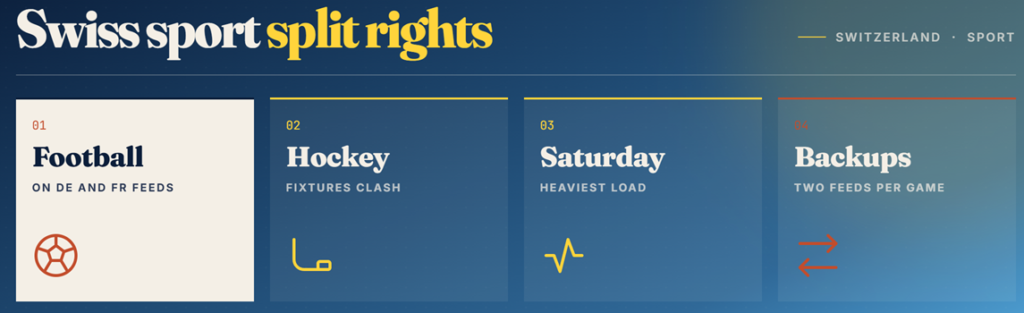
- Football coverage: Super League fixtures usually appear through the German and French sport feeds rather than a dedicated Swiss channel.
- Hockey scheduling: National League games clash with European fixtures, so check that concurrent streams are permitted on your plan.
- Peak-hour load: Saturday evenings are the real test, when every provider carries its heaviest concurrent viewing of the week.
- Backup feeds: Good providers list two or three sources per fixture, which saves the evening when the primary feed stalls.
Test a live fixture during the trial rather than judging quality on an afternoon film.
What Swiss Fibre Speeds Mean for 4K Streams
Switzerland has some of the best broadband coverage in Europe, and that changes the calculation compared with most markets. Bandwidth is rarely the limiting factor here, so problems that would be blamed on the line elsewhere usually point at the provider’s own servers instead.
- Bandwidth headroom: A single 4K stream needs roughly 25 Mbps, which almost every Swiss fibre connection supplies several times over.
- Wired over wireless: Ethernet to the main television removes the most common cause of stuttering during crowded evening viewing windows.
- Server location: European server clusters matter more than raw speed, since latency to a distant cluster becomes start-up delay.
- Router ageing: Older operator-supplied routers throttle concurrent streams long before the fibre line itself reaches any limit.
If a stream stutters on Swiss fibre, the provider is almost always the problem.
Is IPTV Legal in Switzerland?
Swiss copyright law treats the viewer differently from most of its neighbours, which is why the question comes up so often here. Downloading and streaming for private use has historically not been penalised, while the operators supplying unlicensed content sit on far weaker ground legally.
- Private use position: Swiss law has long tolerated private consumption, unlike Germany and France where viewers face direct exposure.
- Provider liability: Services distributing unlicensed streams remain exposed regardless of how their subscribers are treated legally.
- Licensed versus grey: A provider that publishes its licensing arrangements is a materially safer choice than one that stays silent.
- Cross-border viewing: Travelling with a subscription places you under the rules of the country you happen to be watching from.
Our broader guide to IPTV legality covers the detail in full for readers who want it.
Paying in Francs, Renewals and Refund Windows
None of the providers here quote Swiss francs natively, so every payment involves a conversion step. That is not necessarily expensive, but it does mean the figure on the storefront is never quite the figure that lands on the statement at the end of the month.
- Conversion spread: Card issuers typically add one to two percent on a euro charge, and rather more on dollar storefronts.
- Renewal pricing: Confirm that the second term costs the same as the first, since promotional entry rates rarely carry over.
- Refund windows: Most services here offer a short guarantee period, but it usually excludes accounts that have streamed heavily already.
- Payment methods: Crypto and card options differ in whether a chargeback is realistically available if the service degrades.
For a wider view of pricing, see our breakdown of IPTV costs.
Final Verdict
There is no single answer for every Swiss household, but the decision splits cleanly along language lines. If the household watches across German, French and Italian, the trilingual specialist is the obvious starting point and the two-year term makes it cheap. If catalogue breadth matters more than curation, the largest provider here earns the nod instead, and its lifetime licence changes the long-run maths considerably. And if three screens run at once on a Saturday evening, choose on the concurrent-connection allowance rather than the headline monthly price, because that is where the yearly totals actually separate.
Top 3 Recommended IPTV Services for Switzerland
- StreamingNordic IPTV: broad European coverage, a large catalogue, and a free trial.
- OrigineTV: the deepest catalogue here, plus a genuinely useful lifetime licence.
- IPTV Harmony: the strongest option for German-speaking cantons, with Austrian feeds included.
FAQs
Which IPTV service is best in Switzerland?
StreamingNordic IPTV is the strongest all-round choice for Switzerland when broad European coverage matters, because its regional packages, large catalogue, multi-screen options, and free 24-hour trial fit multilingual households that watch across borders.
Can I watch Super League football with IPTV in Switzerland?
Yes, though fixtures usually arrive through the German and French sport feeds rather than a dedicated Swiss channel. Test a live match during the free trial window before committing to any longer term, since evening load is the real test.
Is IPTV legal in Switzerland?
Swiss copyright law has historically not penalised private viewing, which differs sharply from Germany and France. The providers distributing unlicensed content remain exposed, so favour services that publish their licensing arrangements openly rather than staying silent.
Do these providers offer a free trial?
USA LIVE IPTV is the relevant replacement in this iptv in switzerland comparison because its extensive US local network selection complements the European services already ranked above it. 30-day guarantee is the clearest opportunity to confirm performance before choosing a longer term.
How much does IPTV cost per year in Switzerland?
Annual plans in this guide range from roughly fifty-nine euros up to one hundred and twenty dollars. Most Swiss households land somewhere near seventy euros once the card conversion charge has been added at the checkout stage.
Will one subscription work on two televisions?
Only if the plan permits concurrent connections. Several services here charge extra for a family tier, so check the simultaneous stream allowance carefully rather than assuming that a single account will cover both televisions.
Which device works best for IPTV in Switzerland?
An Apple TV or Nvidia Shield gives the most stable playback, though a Fire TV Stick 4K handles the same streams perfectly well. A wired ethernet connection matters considerably more than the choice of device itself.
What internet speed do I need for IPTV?
Around 25 Mbps supports a single 4K stream comfortably, and roughly 10 Mbps handles high definition without trouble. Swiss fibre connections exceed both figures easily, so stuttering almost always points at the provider instead.
Can I pay in Swiss francs without conversion fees?
No provider in this guide quotes Swiss francs natively, so a conversion always applies at checkout. Euro storefronts generally cost less on a Swiss card than dollar ones, typically adding only one to two percent.