
Key Takeaways
An IPTV headend is the upstream system that receives authorized television and video sources, prepares them for IP delivery, adds service information and protection, and hands streams to a managed network, origin, or CDN. It can include receivers, encoders, transcoders, multiplexers, packagers, middleware connections, monitoring, and redundancy, but it is not the player or set-top box at the viewer’s screen.
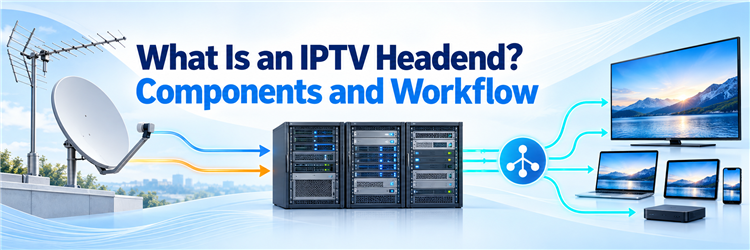
An IPTV headend is where television channels and video sources become organized IP services. Upstream of the distribution network, it receives authorized feeds, converts incompatible formats, assembles channels and metadata, protects content, and produces streams for delivery. It may occupy physical racks, run on standard servers, or use cloud services.
The name can be misleading because a modern headend is rarely one box. Its boundary changes by deployment: a hotel may use compact appliances, while a telecom operator separates ingest, transcoding, packaging, control, origins, and delivery. This guide explains the common functions without assuming identical equipment.
IPTV Headend: The Short Answer
An IPTV headend is the source-side system that acquires legitimate video feeds and prepares them for distribution over an IP network. I think of it as the service’s production and traffic-control layer: it receives, normalizes, compresses, groups, labels, protects, and monitors channels before a managed network, origin, or CDN delivers them. The viewing device is downstream and normally only requests, receives, authorizes, decodes, and displays the selected stream.
Methodology and Sources
I checked the ITU IPTV architecture, DVB-IPTV specification, Apple HLS documentation, IETF RTP standard, AWS live-workflow documentation, SRT documentation, and WIPO retransmission guidance. Product pricing and performance are excluded because this guide explains functions rather than vendors.
Where a Headend Sits in the Delivery Chain
The headend begins after content acquisition and ends where prepared services enter distribution. Upstream are studios, playout, satellite or terrestrial broadcasts, cable feeds, and IP contribution links. Downstream are multicast networks, origins and CDNs, or managed venue networks. Middleware and rights systems connect across the chain so authorization, channel data, and playback policy follow the media.
| Layer | Main job | Typical output |
|---|---|---|
| Content source or contribution | Supply an authorized live program or file | RF, SDI, HDMI, ASI, or IP feed |
| IPTV headend | Receive, process, assemble, protect, and monitor services | Multicast streams, contribution outputs, or packaged renditions |
| Distribution | Move prepared streams toward viewers | Managed IP delivery, origin/CDN delivery, or venue LAN |
| Endpoint | Authorize, receive, decode, and display | Picture, sound, captions, and guide interface |
A system integrator may draw these boundaries differently, especially when packaging or middleware is delivered as a separate platform. The useful test is the function, not the product label.
Core Components of an IPTV Headend
A headend combines only the modules its service needs. A small campus may reuse incoming compressed streams, while a broadcaster may create several formats, bitrates, languages, and protection profiles for different devices.
- Acquisition: Antennas, dishes, cable inputs, contribution decoders, IP gateways, or playout outputs bring authorized source programs into the facility.
- Receivers and demodulators: These recover transport streams from RF carriers and expose selected services through ASI, SDI, HDMI, or IP.
- Encoders and transcoders: Encoders compress baseband sources; transcoders convert compressed streams into compatible codecs, resolutions, frame rates, or bitrate renditions.
- Multiplexers: These combine programs, select elementary streams, manage identifiers, and maintain timing and service-information tables.
- Packagers and gateways: These create HLS or DASH manifests and segments, or convert formats without necessarily changing the codec.
- Control systems: Middleware, EPG, entitlements, DRM or conditional access, channel maps, and monitoring turn video into a managed service.
Storage, catch-up, ad insertion, analytics, and video-on-demand may live beside the headend, but they are not mandatory parts of every design.
The End-to-End IPTV Headend Workflow
The workflow is easiest to understand from left to right. Each stage should have a defined input, output, owner, monitoring point, and recovery path.
- Acquire the source: Receive an authorized RF, SDI, HDMI, file, or IP feed and confirm its format, rights, and schedule.
- Recover the program: Tune and demodulate RF when required, using licensed receiver functions only for entitled services.
- Normalize the media: Map video, audio, captions, languages, timestamps, and metadata; correct unsupported formats.
- Encode or transcode: Create the required codec, resolution, frame rate, audio, and bitrate outputs.
- Assemble the service: Multiplex tracks and channels, maintain identifiers and timing, attach metadata, and prepare access-control signalling.
- Protect and package: Apply authorized conditional access or DRM, then create transport streams, manifests, segments, or protocol-specific outputs.
- Distribute and monitor: Send streams through multicast, unicast, an origin/CDN, or venue network while measuring health and failover.
- Play at the endpoint: Middleware authorizes the request; a box, television, decoder, or player renders the compatible stream.
One platform can perform several stages, but preserving these logical checkpoints makes failures much easier to isolate.
Headend vs Encoder, Middleware, Origin, CDN, and Player
These terms overlap in product brochures, but they describe different responsibilities. A headend is the coordinated upstream system; the other names identify one function or location.
| Term | Primary responsibility | What it is not |
|---|---|---|
| Encoder | Turn baseband or raw media into a compressed stream | The complete headend or subscriber platform |
| Transcoder | Re-encode an existing compressed stream into another format or rendition | A simple transport relay or player |
| Multiplexer | Combine programs or elementary streams with timing and signalling | A codec or viewer interface |
| Middleware | Manage services, users, entitlements, channel maps, EPG, and session logic | The video-compression engine or CDN |
| Origin server | Hold or expose packaged streams and manifests to downstream delivery | A global cache network or endpoint decoder |
| CDN | Replicate and cache content closer to distributed viewers | The ingest, authorization, or encoding system |
| Decoder or player | Reconstruct and present the stream | The upstream production system |
| Set-top box | Authorize, decode, and output video | A headend, source, or distribution right |
A commercial platform may integrate several rows. Integration changes the packaging, not the underlying jobs.
Hardware, Software, and Cloud Headends Compared
Hardware headends use dedicated receivers, chassis, encoders, gateways, and switches. They fit fixed lineups, direct RF connections, and facilities wanting predictable interfaces and local control. Capacity expands through cards, ports, appliances, and spares.
Software headends run on servers or virtual machines. They ease automation, rapid channel creation, and resource pooling, but depend on host sizing, accelerators, drivers, storage, and orchestration. Software still needs resilient inputs and networks.
Cloud headends use hosted ingest, transcoding, packaging, origin, monitoring, and delivery. They suit temporary events, geographic reach, and elastic workflows, but egress, service limits, connectivity, permissions, and recurring costs matter. Hybrid systems keep receivers on-site while moving processing elsewhere.
Codecs, Protocols, Distribution, and Capacity
A codec compresses media; a container organizes tracks and timing; a protocol carries data; and unicast or multicast describes how receivers obtain it. Treating them as interchangeable causes compatibility problems.
- Codecs: H.264/AVC is broadly compatible; H.265/HEVC can improve efficiency where the complete chain supports its selected profile and level.
- Packaging: MPEG transport stream is common in managed IPTV; fragmented MP4 is common in CMAF-based HLS and DASH.
- Protocols: RTP/UDP, SRT, RIST, and RTMP serve contribution, while HLS and DASH commonly connect origins or CDNs to internet viewers.
- Multicast: One channel flow serves many joined receivers efficiently, but requires correct routing, IGMP behavior, and controlled network scope.
- Unicast: Each session receives its own flow or HTTP requests, making concurrency, origins, caches, and egress capacity important.
- Capacity: Count every channel, audio track, rendition, redundant output, and path, then add overhead, peaks, monitoring copies, and growth.
- Quality: Resolution, frame rate, motion, codec, GOP, and encoder implementation affect bitrate; upscaling cannot restore missing detail.
- Latency: Add acquisition, processing, packaging, network, buffering, decoding, and display delay rather than quoting one appliance.
- Adaptive streaming: Align keyframes and segment boundaries across renditions so players can switch cleanly as bandwidth changes.
Endpoint requirements should determine the output matrix. Size links and compute for peaks, failover, maintenance, concurrent viewers, and the hardest expected content; then measure glass-to-glass delay with representative programs.
Middleware, EPG, Access Control, and Content Rights
Middleware turns streams into an organized service. It can publish channel maps, associate EPG data, authenticate users or rooms, enforce entitlements, and return a playback address. Video may bypass the middleware server itself.
Conditional access commonly protects broadcast transport streams, while DRM typically protects packaged streams and licenses supported clients. Encryption alone is not subscriber control: keys, entitlements, policy, rotation, revocation, and endpoints must work together.
Decryption must be limited to feeds the operator may receive and redistribute. A subscription, receiver, smart card, or key does not automatically grant hotel, campus, territorial, catch-up, or internet-retransmission rights. Confirm contracts and local law.
Redundancy, Monitoring, and Security
Reliable headends remove single points of failure across the whole path, not only the encoder. Depending on service impact, that may mean dual feeds, receivers, power, switches, processing pipelines, packagers, origins, network routes, and sites.
- Input health: Track RF lock, continuity errors, packet loss, jitter, silence, black video, captions, and clocks.
- Processing health: Watch load, dropped frames, latency, bitrate, GOP behavior, synchronization, service tables, and output continuity.
- Delivery health: Test multicast joins, manifest freshness, segments, origin errors, authorization, startup time, and playback quality.
- Failover: Paired inputs and downstream systems must be independent, and recovery must be tested under load.
- Management security: Isolate control interfaces, remove default credentials, use least privilege, patch software, log changes, and protect secrets.
- Actionable alarms: Define thresholds, escalation owners, and service-impact alerts instead of collecting unused metrics.
End-to-end probes at representative endpoints catch problems that component health pages can miss.
Deployment Examples and a Practical Selection Checklist
Hotels use compact headends to create a controlled lineup and multicast it across a building. Campuses and healthcare facilities add permissions, emergency messaging, accessibility, and segmented networks. ISPs and broadcasters run larger redundant systems feeding managed networks, origins, CDNs, and many devices.
Before selecting equipment or software, document the service rather than starting with a product catalog.
- List sources and rights: Record every feed, format, program, territory, audience, retention rule, and approved redistribution method.
- Define endpoints: Capture codecs, audio, captions, resolutions, containers, protocols, DRM, channel-change targets, and network conditions.
- Build the matrix: Multiply channels by renditions, languages, destinations, redundancy, and concurrency; add headroom.
- Design operations: Specify alarms, logs, backups, access roles, patching, change control, spares, and recovery objectives.
- Prove one path: Validate a representative source through the complete chain before scaling channels or formats.
- Test failure modes: Remove an input, route, node, or origin and verify monitoring and recovery.
The IPTV encoder guide provides a deeper checklist for the compression stage inside this larger workflow.
Troubleshooting Signals and Common Misconceptions
Troubleshoot by locating the first point where a known-good signal becomes wrong. Check the source, headend output, distribution edge, and endpoint separately; changing several variables at once destroys useful evidence.
| Symptom | Likely area | First useful check |
|---|---|---|
| Several channels disappear together | Shared receiver, multiplex, route, or entitlement | Check common input lock, tables, and alarms |
| One channel breaks on every device | Source, encode, service assembly, or packaging | Compare ingest preview with each headend output |
| One device family fails | Codec, profile, audio, DRM, container, or client | Match exact stream properties to endpoint support |
| Multicast works locally but not elsewhere | VLAN, IGMP, routing, scope, or ACL | Verify group joins and packet flow at each boundary |
| Internet playback stalls | Contribution loss, origin, CDN, bitrate, or player buffer | Compare input health, manifest freshness, requests, and endpoint metrics |
| Audio drifts or languages are wrong | Mapping, clocks, timestamps, or metadata | Inspect selected PIDs/tracks and decode on a second endpoint |
A headend does not create content rights, guarantee picture quality, replace middleware, or eliminate network engineering. “Cloud” does not mean hands-off operation, and “all-in-one” does not remove failure domains.
Final Verdict
An IPTV headend is the upstream system that converts authorized sources into organized, protected, observable IP television services. Its practical boundary can include receivers, encoders, transcoders, multiplexers, packagers, metadata, middleware integrations, origins, and monitoring, but each function remains distinct. Start with rights and endpoint requirements, draw the complete signal path, size every output and failure case, then validate one representative channel end to end. A dependable headend is defined less by one appliance than by compatible interfaces, measurable service health, controlled access, and tested recovery.
FAQs
Is an IPTV headend the same as an encoder?
No. An encoder compresses a source. A headend is the wider system that may include receivers, encoders, transcoders, multiplexers, packaging, protection, metadata, monitoring, and distribution handoff.
Does every IPTV headend need satellite dishes?
No. Sources can arrive through satellite, terrestrial antenna, cable, SDI, HDMI, files, private fiber, or IP contribution. The receiving equipment must match the authorized source.
Can an IPTV headend run entirely in the cloud?
Sometimes. IP or file-based sources can feed cloud processing directly, while RF reception usually needs an on-site receiver or gateway before contribution to the cloud.
What is the difference between a headend and middleware?
The headend prepares media services. Middleware organizes channels, users, EPG data, entitlements, and sessions. They integrate closely, but middleware does not normally perform every media-processing step.
Does a headend use multicast or unicast?
It can use both. Managed networks often distribute popular live channels by multicast, while interactive, adaptive, internet, and individually authorized sessions commonly use unicast or HTTP delivery.
What codecs do IPTV headends use?
H.264/AVC and H.265/HEVC are common, with audio such as AAC or Dolby formats where licensed and supported. The correct choice depends on every downstream endpoint.
How is an IPTV headend different from an OTT platform?
Managed IPTV often controls the access network and can use multicast; OTT commonly uses adaptive HTTP delivery across the open internet. The OTT comparison explains that boundary.
Is it legal to build an IPTV headend?
The equipment is legal, but receiving and redistributing content requires appropriate rights, licenses, territory, audience, and protection controls. Authorized reception alone may not permit retransmission.