
Key Takeaways
- OTT uses the open internet; standards-based IPTV uses an operator-managed network.
- Compare delivery control, device support, and the full subscription cost.
- A delivery technology does not by itself establish content rights.
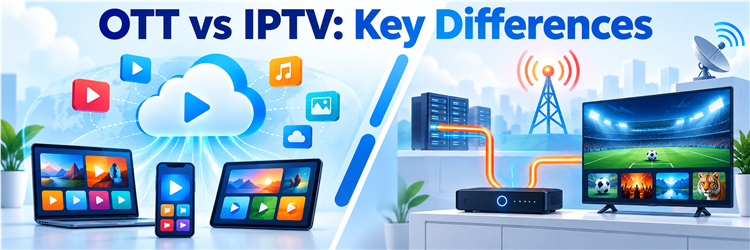
OTT and IPTV both deliver television over internet protocol, but they do not use the internet in the same way. The practical difference is who controls the delivery path. OTT sends video across the open internet, while standards-based IPTV runs inside a managed network designed by the service operator.
That distinction affects setup, device freedom, reliability, latency, and what appears on the bill. It does not automatically decide which service has better content or legal rights. This OTT vs IPTV comparison separates the underlying delivery models from the marketing labels so you can judge each option on evidence.
OTT vs IPTV: My Quick Take
Choose OTT when you value easy sign-up, broad device support, and the ability to watch through almost any reliable internet connection. Choose managed IPTV when an operator offers a tightly integrated television service and predictable in-home delivery. Neither model always wins: the provider, access network, device, app, and content rights matter as much as the label.
Methodology and Sources
I compared the ITU definition of IPTV with Ofcom’s OTT delivery description. I also checked Apple’s HLS documentation and the Netflix Open Connect overview to verify how adaptive streaming and distributed caches work. Product features were checked against current provider pages on September 14, 2026; service performance was not independently lab-tested.
What Is OTT?
OTT, or over-the-top video, reaches viewers through the public internet rather than a television operator’s managed service network. A video provider typically uses apps, web players, content delivery networks, and adaptive HTTP streaming. The stream can change quality as bandwidth changes, but the provider normally does not control every network between its servers and your screen.
OTT can be live or on demand. Subscription streaming apps, broadcaster catch-up services, free ad-supported channels, and rented movies can all use this model. “OTT” describes delivery, not a particular genre or payment plan.
What Is IPTV?
In the standards-based sense, IPTV is television delivered over an operator-managed IP network with controls for quality of service, reliability, security, and interactivity. It is commonly tied to a broadband subscription and supplied through an operator box, gateway, or approved app.
Live channels may use multicast, which lets the network send one stream efficiently to many subscribers. On-demand programs usually use unicast. Some sellers use “IPTV” loosely for any internet channel playlist, but a playlist crossing the open internet behaves more like OTT delivery than a managed operator service.
OTT vs IPTV: Key Differences
| Factor | OTT | Managed IPTV |
|---|---|---|
| Delivery path | Open internet | Operator-managed IP network |
| Network control | Limited end-to-end control | Operator controls the service path |
| Typical access | App or browser account | Broadband bundle, box, or approved app |
| Live delivery | Usually per-viewer unicast | Often multicast, with unicast where needed |
| Device reach | Usually broad | Often limited to supported hardware or network |
| Quality behavior | Adapts to internet conditions | Can receive managed QoS inside the operator network |
| Travel use | Often available wherever rights permit | May be tied to the subscriber’s home network |
These are typical patterns, not universal promises. A well-engineered OTT platform can outperform a weak IPTV deployment, and a provider may combine both models.
The labels also say little about the catalogue. Either model can carry linear channels, catch-up television, movies, or subscription video. To classify a service accurately, follow the stream from source to screen and ask which company manages each network segment.
Delivery Architecture and Network Control
OTT providers place copies of video on distributed servers, then send an individual adaptive stream to each viewer. Caches can sit inside or near an internet service provider, reducing distance and congestion. That optimization improves delivery, but it does not by itself turn OTT into managed IPTV.
With IPTV, the operator can plan capacity, prioritize television traffic, monitor the service path, and coordinate the home gateway and receiver. Multicast is efficient for popular live channels because viewers can join an existing network stream. Unicast remains useful for pause, replay, catch-up, and on-demand viewing.
This control boundary is more important than the protocol name. Both systems may use internet protocols, encryption, electronic guides, and account authentication. The managed IPTV operator additionally controls the access environment in which the television service is delivered.
Content Access and Device Support
OTT usually starts with an account and an app. Smart TVs, phones, tablets, computers, streaming sticks, and game consoles may all be supported, although each platform sets its own device, location, and simultaneous-stream rules. Travelling is easier when the service and content licence allow it.
Managed IPTV commonly starts with installation or activation from the broadband operator. The supplied receiver can simplify the remote, channel guide, recording, and billing experience, but it may reduce hardware choice. Some operators now offer companion apps, creating a hybrid service that uses managed delivery at home and OTT elsewhere.
Device support should be checked by model, operating-system version, and region. A logo on an app store does not guarantee every feature. Confirm subtitles, audio tracks, parental controls, accessibility options, downloads, casting, and external-screen restrictions where those functions matter.
Picture Quality, Reliability, and Latency
Managed IPTV has an architectural advantage inside its own network: the operator can reserve capacity and apply quality controls. That can produce steady channel changes and predictable television performance even when other household devices are busy. It still cannot prevent every outage, Wi-Fi problem, or faulty receiver.
OTT quality depends more visibly on available bandwidth, routing, congestion, CDN placement, player design, and Wi-Fi. Adaptive streaming may lower resolution or buffer when conditions deteriorate. Live OTT also tends to add processing and buffering delay, but low-latency technologies can narrow the gap. Fixed “OTT is X seconds slower” claims are unreliable across providers and devices.
Test reliability at the times you actually watch. A short daytime trial may miss evening congestion, while one speed test may miss packet loss or unstable Wi-Fi. When possible, compare Ethernet and wireless playback before blaming the delivery model.
Costs: What You Actually Pay For
OTT can look inexpensive because sign-up is quick and many apps require no dedicated receiver. The full cost may include broadband, several subscriptions, premium sports packages, rentals, and extra simultaneous streams. Mobile viewing can also consume metered data.
Managed IPTV often appears on one bill with broadband, installation, equipment, and optional channel packs. Introductory pricing can hide a higher renewal rate, so compare the normal monthly total, contract term, receiver fees, recording limits, and cancellation conditions. Our cable comparison covers the separate trade-offs against traditional coaxial television.
There is no universal cheapest model. A household using one OTT service may spend less, while a broadband-and-TV bundle may be competitive for a family that wants live channels on several televisions.
Where Each Model Fits Best
- OTT fits flexible viewers: choose it when you switch devices, travel, prefer monthly app subscriptions, or mainly watch on-demand programs.
- Managed IPTV fits integrated households: choose it when a local operator offers the channels you need, a familiar television interface, and reliable service over its own broadband network.
- Hybrid delivery fits mixed needs: a provider may serve the living-room box through managed IPTV and its mobile or out-of-home app through OTT.
Before choosing, list your must-have channels, home internet speed, supported screens, travel needs, accessibility features, recording expectations, and total budget. Test the actual app and device combination when a trial is available. For live sports, compare real delay and stability during a busy event rather than relying on a headline claim.
Finally, verify content rights and seller identity. Delivery architecture does not prove that a service is licensed, and the word “IPTV” is not a legality test. A transparent provider should explain its company details, payment terms, device limits, support route, and refund policy.
IPTV Services to Compare in 2026
The next three are current sponsored partners, not substitutes for an operator-managed IPTV bundle. Check local content rights, channel availability, device support, and refund terms yourself. Where a trial is offered, use it to test your own connection before committing.
StreamingNordic IPTV
StreamingNordic advertises live channels, on-demand content, device choices, and a request-based 24-hour trial. I would use that trial to check regional channels, peak-hour stability, guide data, and support response on the exact player you plan to keep.
OrigineTV
OrigineTV advertises live television, a large on-demand library, M3U access, and support for several device types. My first check would be whether its advertised catalogue matches your country and whether playback, subtitles, and channel switching remain consistent during a trial.
USA LIVE IPTV
USA LIVE IPTV presents a US-oriented live and on-demand offer with multi-device access. I would confirm the current channel list, simultaneous-connection policy, compatible app, and refund conditions directly, then evaluate it on your home network before selecting a longer plan.
Final Verdict
The key difference is control of the delivery network. OTT offers reach and device freedom over the open internet; managed IPTV gives an operator more control over capacity, quality, and the television experience. Choose from your real viewing needs and total cost, then verify performance on your own connection. Treat content rights, customer support, and seller transparency as separate checks instead of assuming either architecture guarantees them.
Top 3 IPTV Services
FAQs
Is Netflix OTT or IPTV?
Netflix is generally classed as OTT because it delivers video over the open internet through apps and web protocols. Its caches may sit close to viewers, but Netflix does not operate the customer’s end-to-end managed television network.
Can IPTV work without the internet?
IPTV needs an IP network, but managed television traffic may stay inside the operator’s network instead of crossing the public internet. Your provider’s design determines whether television continues during a wider internet service problem.
Is OTT always cheaper than IPTV?
No. One OTT subscription can be inexpensive, but several apps, sports add-ons, broadband, and extra streams add up. Compare the normal total after promotions with IPTV equipment, installation, contract, and channel-pack fees.
Which has better picture quality?
Managed IPTV can offer predictable quality because the operator controls capacity and traffic priorities. High-quality OTT can look equally strong on a fast, stable connection. The source encode, player, device, Wi-Fi, and display also matter.
Why is live OTT sometimes delayed?
Encoding, packaging, distribution, adaptive buffering, app behavior, and the final internet connection can each add delay. Low-latency streaming reduces it, but no single delay figure applies to every OTT service, event, or device.
Does IPTV always use a set-top box?
No. A managed IPTV operator may provide a set-top box, a supported smart-TV app, or both. The defining feature is the managed delivery service, not the physical shape of the receiver.
Can one provider offer OTT and IPTV?
Yes. A telecom operator can deliver channels to the home through managed IPTV while using OTT for mobile, browser, or out-of-home viewing. The interface may look similar even though the delivery path changes.
Is every service called IPTV a managed service?
No. Marketing often uses IPTV for any internet-delivered channel service. Our IPTV guide explains the wider terminology. Ask whether the seller controls the network, supplies the access connection, and can actually provide managed quality of service.