
Key Takeaways
- Compare delivery method, reliability, devices, and the total recurring bill.
- Internet-delivered television depends on the network and service quality.
- Check required channels and content rights before replacing cable.
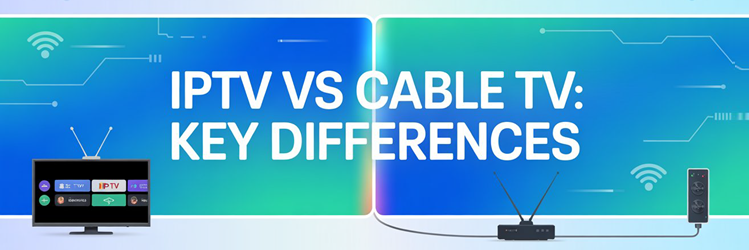
If you are weighing up whether to cut the cord, the choice usually comes down to IPTV versus traditional cable TV. They both put channels on your screen, but they work in completely different ways, cost very different amounts, and suit different kinds of viewer. Cable is the familiar, reliable option that arrives through a coaxial wire; IPTV streams the same kind of content over your internet connection, often for a fraction of the price.
I have used both for years, and neither is simply better than the other. This guide breaks down the real differences in cost, channels, quality, and reliability, so you can decide which one actually fits how your household watches television. By the end you should know exactly which way to lean and what you would be giving up either way.
My Quick Take on IPTV vs Cable
For most people who mainly want a huge channel selection, on-demand films, and a much smaller bill, IPTV wins comfortably. Cable still makes sense if you value guaranteed reliability, local channels, and a single provider to call when something breaks, and you do not mind paying a premium for it. If your internet is stable and reasonably fast, IPTV gives you more for less; if it is not, cable’s dependability is worth the extra cost.
Methodology and Sources
This comparison is based on hands-on use of both cable packages and a range of IPTV services, checked against current provider pricing at the time of writing. IPTV players are legal, neutral apps, and the legality of what you stream depends on whether your provider licenses its channels. I have kept the comparison practical rather than technical, focusing on the things that actually change your day-to-day viewing: what you pay, what you can watch, how good it looks, and how often it lets you down.
What Is IPTV?
IPTV stands for Internet Protocol Television. Instead of receiving channels through a cable, satellite dish, or aerial, IPTV delivers them as data over your internet connection, the same way Netflix or YouTube streams video. You watch through an app, called a player, on a device you already own, such as a Fire TV Stick, an Android TV, a smart TV, or a phone. A subscription gives you a login, the player turns that login into a channel list, and you stream live TV and on-demand content on demand. Because it runs over the internet, IPTV can carry far more channels than a cable line and add features like catch-up and a huge film library.
What Is Cable TV?
Cable TV delivers channels through a physical coaxial cable run into your home by a local provider. It is the traditional model most households grew up with: you pick a package, a technician or a self-install kit connects a set-top box, and you watch live channels through that box on your TV. Cable is a closed, managed system, which is its great strength. The provider controls the whole chain from broadcaster to box, so picture quality is consistent, local and regional channels are included, and there is a single company responsible when something goes wrong. That reliability and simplicity come at a price, and that price is usually the main reason people start looking at IPTV.
IPTV vs Cable TV: Key Differences
The two share a purpose but differ on almost every practical measure. This table sums up how they compare on the points that matter most when you are choosing between them.
| Feature | IPTV | Cable TV |
|---|---|---|
| Delivery | Over the internet | Coaxial cable |
| Typical cost | Roughly $10–15 a month | Often $80–120 a month |
| Channels | Thousands, international | Hundreds, mostly local |
| On-demand library | Large, built in | Limited or extra cost |
| Contract | Usually none | Often 12–24 months |
| Devices | Fire Stick, smart TV, phone | Provider set-top box |
| Reliability | Depends on your internet | Very consistent |
| Local channels | Varies by provider | Always included |
Cost: IPTV vs Cable TV
Cost is where the gap is widest and where IPTV wins most clearly. A typical cable package runs from around $80 to well over $120 a month once equipment rental, regional fees, and taxes are added, and prices often jump after an introductory period. A comparable IPTV subscription usually costs between $10 and $15 a month, sometimes less on a long plan, with no set-top box rental and no surprise fees. Over a year that difference adds up to hundreds of dollars. The trade-off is that cable’s price buys a guaranteed, licensed, supported service, whereas IPTV quality varies by provider, which is why testing a trial first matters so much. It is also worth remembering that cable’s advertised price is rarely the final one, as introductory rates expire and equipment and regional fees are added on top, whereas a good IPTV plan quotes a single figure that does not change for the length of the term.
Channels, Sport, and On-Demand
On sheer choice, IPTV is in a different league, typically offering thousands of channels from around the world alongside a built-in library of films and series. Cable offers a more curated few hundred, weighted toward your local and national networks. For international sport and foreign-language channels, IPTV is usually the only practical option. Cable, however, holds a real advantage on local channels and certain premium sports rights, which are always included and always licensed. If your viewing is mostly local news, network shows, and one or two sports, cable covers it neatly; if you want everything, everywhere, IPTV is unmatched.
Picture Quality, Reliability, and Flexibility
Cable’s closed system gives it consistent picture quality and rock-solid reliability; it rarely buffers and does not care how busy your home internet is. IPTV can match or beat cable on picture quality, with plenty of full-HD and 4K feeds, but it leans entirely on your connection, so a weak or congested line means buffering. Where IPTV pulls ahead is flexibility: you can watch on any device, anywhere, cancel any time, and there is no technician visit or contract. Cable ties you to a box, a room, and usually a lengthy contract. For a mobile, multi-device household, that flexibility is a major draw.
Switching From Cable to IPTV: What to Expect
Moving from cable to IPTV is less daunting than it sounds, but a few things change on day one and it helps to know them in advance. The biggest shift is that you become your own installer: instead of a technician and a set-top box, you download a player, paste in a login, and you are running. Most people are surprised how quickly it comes together, and how much control they suddenly have over what they watch and on which screen.
- Your internet does the work: A stable connection replaces the coaxial line, so a good router matters more than ever.
- No box to rent: You watch on a Fire Stick, smart TV, or phone you already own, ending equipment fees.
- Trials before you commit: Test an IPTV service alongside your existing cable before you cancel anything.
- Local channels need a plan: Add a cheap antenna or streaming app if reliable local news matters to you.
Run the two side by side for a week, compare the channels and stability you actually use, and only cancel cable once you are confident the IPTV service covers your household. That overlap costs a little but removes all the risk from switching.
Top IPTV Services to Try in 2026
If the comparison has you leaning toward IPTV, these are three services I have tested and trust, each with a trial or money-back window so you can see how streaming compares with your current cable before you commit.
Tellystudio
Tellystudio offers a flexible alternative to a fixed television contract, combining 45,000-plus live channels, 120,000-plus on-demand titles, and support for familiar streaming devices. I would compare its $16 monthly price, trial access, and evening playback against the household cost of cable.
USA LIVE IPTV
USA LIVE IPTV is the pick for anyone leaving cable but keeping their sport, with deep US networks, PPV, and around 20,000 channels. A 30-day money-back guarantee covers the first month, so you can compare it directly against your old cable package.
OrigineTV
OrigineTV offers the widest library of the three, about 55,000 channels and 270,000 on-demand titles, plus a lifetime option. A free 24-hour trial makes it easy to see whether it can replace your cable subscription outright.
Which Should You Choose?
Choose IPTV if you want the biggest possible channel and film selection, a much lower bill, and the freedom to watch on any device without a contract, and if your internet is stable enough to support it. Choose cable if reliability is non-negotiable, you rely on local channels, you want a single company to hold accountable, and you are willing to pay a premium for that peace of mind. Many households now run IPTV as their main service and keep a cheap streaming option for local news, which captures most of the benefits of both.
Final Verdict
IPTV versus cable is really a trade between value and dependability. IPTV gives you far more content for far less money, with unmatched flexibility, as long as your connection can carry it. Cable gives you guaranteed reliability, local channels, and one throat to choke when something breaks, at a price that keeps climbing. For most modern households with decent broadband, IPTV is the smarter buy, provided you pick a reputable provider and test it on a trial first. If your internet is shaky or you cannot live without your local channels, cable still earns its keep.
Top 3 IPTV Services to Start With
- Tellystudio: Deep on-demand library, ideal as a cable replacement.
- USA LIVE IPTV: Best for keeping your sport, with a 30-day guarantee.
- OrigineTV: Widest library, with a free trial and lifetime option.
FAQs
Is IPTV better than cable TV?
For most people IPTV offers more channels, more on-demand content, and a far lower price. Cable is better if you need guaranteed reliability and local channels. The right choice depends on your internet and viewing habits.
Is IPTV cheaper than cable?
Yes, usually by a wide margin. IPTV subscriptions typically cost $10 to $15 a month with no equipment rental, while cable often runs $80 to $120 once fees and taxes are added.
Can IPTV replace cable completely?
For many households, yes. IPTV can cover live channels, sport, and on-demand in one subscription. Some viewers keep a cheap streaming service for local news, which cable includes by default.
Do I need fast internet for IPTV?
Around 25 Mbps handles full-HD comfortably, and 40 Mbps or more is ideal for 4K. A stable connection matters more than a very high headline speed, since congestion is the main cause of buffering.
Is IPTV legal?
IPTV apps are legal, neutral tools. Legality depends on whether the provider licenses the channels it streams. Reputable, licensed services are far safer than unknown sellers offering every premium channel cheaply.
Does cable have better picture quality than IPTV?
Cable is more consistent because it does not depend on your internet, but IPTV can match or beat it with full-HD and 4K feeds. On a strong connection, the difference is usually minimal.
Do I need special equipment for IPTV?
No. IPTV runs on devices you likely already own, such as a Fire TV Stick, smart TV, or phone. Cable requires the provider’s set-top box, which usually carries a monthly rental fee.
Can I keep local channels if I switch to IPTV?
It varies by provider, and local coverage is where cable holds an edge. Many IPTV users add a cheap antenna or a streaming service to guarantee reliable local news and network channels.