
Key Takeaways
An IPTV gateway is a boundary system that receives authorized television streams, selects and reorganizes them when needed, maps them to IP addresses or sessions, and forwards them into another network or delivery format. It may bridge RF, ASI, multicast, unicast, or HTTP streaming environments, but it does not automatically encode video, manage subscribers, grant content rights, or replace the complete headend.
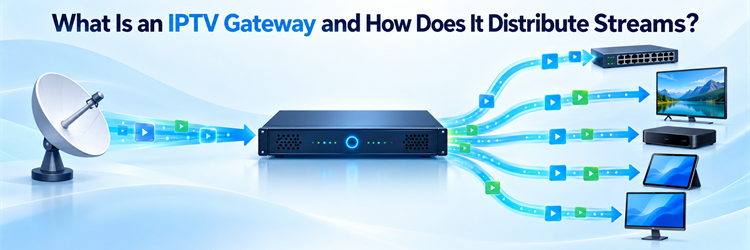
An IPTV gateway moves prepared television streams across a technical boundary. Depending on the deployment, that boundary may be satellite or terrestrial reception to Ethernet, ASI to IP, one IP network to another, multicast to unicast, or a managed operator network to a home network. The gateway receives streams, applies permitted transport-level processing, and exposes outputs that downstream systems can reach.
The name does not describe one universal appliance. A compact hotel unit may tune channels and create multicast groups, while an operator edge gateway may translate protocols without touching the encoded pictures. This guide explains the shared functions, the main distribution models, and the checks that separate a gateway problem from an encoder, network, middleware, or decoder problem.
IPTV Gateway: The Short Answer
An IPTV gateway receives authorized live or on-demand media at one interface and forwards it through another interface, address plan, transport structure, or delivery method. I think of it as a controlled stream junction: it decides which prepared services cross a boundary, how they are identified, and where copies should go. A gateway can filter programs, remap identifiers, convert between SPTS and MPTS, change encapsulation, or relay multicast as unicast, yet a pure gateway normally preserves the existing compressed video and audio.
Methodology and Sources
I reviewed the ITU open IPTV multicast architecture and the current IETF IGMPv3 specification, then cross-checked DVB transport guidance, ITU IPTV architecture material, and current gateway documentation. No appliance was physically tested, so product-specific capacity, compatibility, latency, reliability, and price claims are excluded.
Where an IPTV Gateway Sits in the Chain
The gateway usually sits after a source has become a compressed digital television service but before that service reaches its final distribution network. In an RF headend, receivers or tuner modules recover MPEG transport streams and the gateway puts selected services onto Ethernet. In an IP system, the gateway may instead sit between contribution, core, access, venue, or home networks.
| Upstream side | Gateway boundary | Downstream side |
|---|---|---|
| Satellite, terrestrial, or cable transport | Tune, select, filter, and encapsulate authorized services | SPTS or MPTS over managed IP |
| ASI transport stream | Map physical ASI input to IP addresses and ports. | UDP or RTP unicast/multicast |
| IP contribution network | Validate, remap, route, or convert permitted streams | Headend, origin, or access network |
| Multicast core | Join requested groups and create controlled relays. | Unicast clients or another multicast domain |
| Managed access network | Enforce boundary policy and pass selected services | Home gateway, set-top box, or local switch |
The wider IPTV headend can contain a gateway, encoders, multiplexers, protection, metadata, monitoring, and origins. Calling one module a gateway does not make it the entire headend.
What the Gateway Changes—and What It Usually Preserves
A gateway works mainly at the service, transport, network, and session layers. Its exact feature set depends on the installed tuner, demultiplexer, multiplexer, network interfaces, software licenses, and security modules.
- Input selection: It chooses authorized frequencies, ASI inputs, multicast groups, source addresses, ports, or upstream sessions.
- Program filtering: It can pass only selected programs and their required video, audio, captions, timing, and service-information data.
- Service remapping: It may change program numbers, packet identifiers, multicast addresses, VLANs, ports, or output names to avoid conflicts.
- Multiplex handling: It can split a multi-program transport stream into single-program streams, combine services into a new multiplex, or preserve the incoming structure.
- Protocol adaptation: It may translate between supported transport methods, such as UDP and RTP, or bridge multicast and controlled unicast delivery.
- Monitoring: It can expose input lock, continuity errors, bitrate, packet loss, output state, alarms, and redundant-path status.
Those actions do not necessarily alter the H.264, H.265, MPEG-2, AAC, or other encoded essence. Re-encoding occurs only when the appliance also includes an encoder or transcoder function.
How a Gateway Distributes Streams Step by Step
Distribution begins with a known-good, authorized input and ends with a reachable output plus monitoring evidence. Several stages can happen in one chassis, but keeping them logically separate makes faults easier to find.
- Acquire the input: Tune an RF carrier, accept ASI, join an upstream multicast group, or open a permitted unicast or contribution session.
- Validate the transport: Check lock, packet arrival, continuity counters, timestamps, bitrate, tables, and required elementary streams.
- Select services: Keep the approved programs, audio languages, captions, metadata, and timing while dropping unwanted material.
- Normalize identifiers: Resolve duplicate program numbers or PIDs, preserve clock relationships, and map outputs to the planned address and port scheme.
- Apply authorized access processing: Pass, terminate, or reapply approved protection only when contracts, entitlements, and the system design permit it.
- Create outputs: Produce SPTS or MPTS flows, multicast groups, unicast sessions, or a supported HTTP-based handoff without inventing missing media.
- Forward through the network: Send each flow into the correct VLAN, route, switch fabric, access network, origin, or local distribution system.
- Observe and recover: Measure both input and output, alarm on loss or corruption, and switch to an independent backup path when the design provides one.
The gateway can create many outputs from one incoming multiplex, but it cannot exceed the source rights, available programs, licensed processing, interface bandwidth, or documented session capacity.
Multicast and Unicast Distribution Explained
Multicast sends one addressed flow that interested receivers join. Routers and switches replicate that flow only where membership and routing state require it, so a popular live channel does not need a separate upstream copy for every screen. IGMP communicates IPv4 group and source interest between receivers and neighboring multicast routers; it does not encode the video or guarantee error-free delivery.
Unicast creates an individual delivery relationship for each receiver or downstream server. It fits on-demand playback, remote clients, individualized authorization, HTTP segments, and networks that do not expose multicast. The cost is that concurrent sessions consume separate gateway, server, and link capacity unless caching or another distribution layer reduces duplication.
| Question | Multicast | Unicast |
|---|---|---|
| Copies near the source | Usually one flow per channel | Usually one flow or request path per session |
| Receiver action | Join or leave a group | Open or close an individual session/request. |
| Best fit | Popular live channels on controlled networks | VOD, adaptive streaming, remote or personalized delivery |
| Main sizing concern | Channel bitrate across each replicated link | Concurrent sessions, requests, origin load, and egress |
| Common failure | Missing join, snooping, route, VLAN, or source state | Session, authentication, server, cache, or capacity failure |
Some gateways bridge the models: they join one upstream multicast channel and relay a controlled unicast copy to each requester. That translation changes distribution behavior, not necessarily the codec.
Gateway vs Encoder, Headend, Router, Middleware, and CDN
Product pages often bundle several roles. Identify each by what enters, what changes, and what leaves.
| Component | Primary job | Difference from a gateway |
|---|---|---|
| Encoder | Compress baseband or raw video and audio | Creates the first encoded stream |
| Transcoder | Decodes and re-encodes an existing stream. | Changes codec, resolution, bitrate, or rendition |
| Multiplexer | Combine programs and maintain transport signalling | May be integrated, but does not define the network boundary |
| IPTV gateway | Bridge stream interfaces, transport structures, addresses, protocols, or delivery domains | Moves and adapts prepared services |
| Router or Layer-3 switch | Forward general IP packets between networks | Does not normally select TV programs or repair transport metadata |
| Middleware | Manage users, channels, EPG, entitlements, and sessions | Coordinates service logic rather than media transport conversion |
| Origin or CDN | Store, expose, cache, and scale packaged streams | Serves distributed clients after ingest or packaging |
| Decoder or player | Reconstruct and present video and audio | Works at the receiving endpoint |
The encoder guide explains the upstream compression stage. A combined receiver, encoder, multiplexer, gateway, and middleware server can perform several rows, but its datasheet should still state which functions consume separate licenses or capacity.
Protocol Conversion and Stream Handling
Protocol conversion is useful only when timing, packetization, addressing, and downstream expectations remain compatible. Wrapping an MPEG transport stream in UDP is different from packaging media as HLS segments, and changing RTP to UDP is different from transcoding H.265 into H.264.
- MPEG-TS: Carries programs, elementary streams, timing, and service tables; gateways may pass MPTS, create SPTS outputs, or rebuild a permitted multiplex.
- UDP: Provides lightweight datagram delivery with no built-in recovery, ordering guarantee, or session control.
- RTP: Adds sequence numbers, timestamps, and payload identification that help monitoring and reconstruction, but does not guarantee delivery.
- HTTP streaming: HLS or DASH uses manifests and segments, normally requiring packaging and often an origin; not every transport gateway performs that work.
- Contribution protocols: SRT, RIST, or similar methods can protect a link against loss and network variation when both ends and the latency budget support them.
- VLANs and addressing: Channel plans must prevent duplicate multicast groups, port collisions, loops, and unintended propagation beyond the approved scope.
Preserve program clocks, PCR accuracy, continuity, audio/video synchronization, captions, and keyframe alignment where relevant. A stream that exits the correct port can still be unusable if transport timing or metadata is damaged.
Hardware, Software, and Cloud Gateways
Hardware gateways combine tuners, ASI ports, network interfaces, processing silicon, power, and management in an appliance. They suit fixed RF/ASI boundaries and continuous venue or operator service. Expansion depends on physical inputs, licensed programs, output bandwidth, and chassis limits.
Software gateways run on servers or virtual machines and commonly handle IP-to-IP filtering, remultiplexing, routing, protocol conversion, monitoring, and automation. They can scale flexibly, but network-interface capacity, CPU, memory, timing, drivers, orchestration, and update control remain real constraints.
Cloud gateways are most practical when inputs already reach the cloud over IP. They can connect contribution feeds to packaging, origins, or regional delivery, but recurring compute and egress, service quotas, permissions, and dependence on upstream connectivity must be included. Hybrid designs keep RF reception on-site and move selected IP outputs to hosted processing.
Capacity, Latency, Monitoring, and Redundancy
Capacity starts with the complete output matrix, not the number of input connectors. Add every selected program, duplicate destination, redundant output, monitoring copy, protocol overhead, bitrate peak, and simultaneous unicast session. A 1 Gb/s interface should not be planned as if all of its nominal line rate were continuously usable.
Latency includes receiver buffering, gateway processing, protocol recovery, queuing, network transit, packaging, player buffering, decoding, and display. A gateway that preserves packets may add little processing delay, while remultiplexing, repair, encryption, multicast-to-unicast relaying, or segmentation adds work and buffering.
Monitor input lock, packet arrival, continuity, PCR and timestamps, bitrate, loss, jitter, interface errors, output presence, join behavior, session counts, temperature, resource load, and failover state. Redundancy must cover sources, power, interfaces, switches, gateway nodes, routes, and downstream systems; two processes on one failed host are not independent paths.
Deployment Examples and a Selection Checklist
Hotels, hospitals, campuses, and ships may use RF/ASI-to-IP gateways to place authorized channel lineups on a controlled LAN. Operators use gateways at contribution, core, access, and home-network boundaries. Broadcasters use them to bridge legacy transport streams and IP infrastructure, while monitoring systems create low-impact copies for probes and confidence displays.
Before selecting a gateway, document the service boundary:
- List inputs: Record RF standards, frequencies, ASI, IP protocols, addresses, bitrates, protection, program counts, and source rights.
- Define outputs: Specify SPTS or MPTS, codecs to preserve, UDP/RTP/HTTP requirements, unicast or multicast, VLANs, addresses, ports, and destinations.
- Calculate capacity: Include peaks, duplicated flows, redundant paths, monitoring, simultaneous sessions, interface overhead, and growth.
- Check processing: Confirm filtering, remapping, multiplexing, timing, authorized access control, protocol conversion, and whether any transcoding is actually required.
- Plan operations: Require logs, alarms, APIs, backups, security updates, configuration export, spares, and tested rollback.
- Prove one path: Validate one representative service from source to real endpoint, then add channels and failure cases incrementally.
Use current manuals and a lab test with representative streams. A headline such as “256 channels” is incomplete without input mix, total bitrate, output duplication, protocol, processing, and license assumptions.
Troubleshooting, Security, and Rights
Locate the first boundary where a known-good stream becomes wrong. Compare the gateway input, gateway output, a switch capture or counter, and a representative endpoint before changing several settings.
| Symptom | Likely area | First useful check |
|---|---|---|
| No channels from one RF input | Tuning, signal, receiver, or authorization | Confirm lock and permitted transport-stream presence |
| One service missing from a multiplex | Filtering, program map, PID selection, or entitlement | Compare source tables with configured output selection |
| All multicast fails on one VLAN | IGMP, snooping, querier, route, ACL, or VLAN scope | Verify group membership and packet flow at each boundary |
| Local multicast works but remote clients fail | Multicast boundary or missing relay | Confirm whether unicast translation is required and active |
| Picture works but audio or captions vanish | Elementary-stream filtering or mapping | Check selected PIDs, language descriptors, and output tables |
| Periodic glitches affect every endpoint | Input loss, continuity, timing, overload, or link congestion | Correlate input/output counters and resource alarms |
Isolate management interfaces, remove default credentials, use least privilege, protect configuration backups and keys, disable unused services, and restrict multicast scope. Only receive, decrypt, transform, or redistribute content when the operator has the required source, territory, audience, public-performance, and retransmission rights. A gateway moves streams; it does not create permission to carry them.
Final Verdict
An IPTV gateway is a boundary system that moves prepared television services between interfaces, transport structures, networks, or delivery models. It can select programs, split or rebuild transport streams, remap identifiers, assign multicast groups, create unicast relays, and expose monitoring, often without re-encoding the media. Its value is controlled interoperability: the right authorized streams reach the right downstream systems with compatible timing, addressing, protocols, and protection. Define the exact input-to-output boundary, calculate every flow and failure case, validate a representative path, and monitor both sides. The word “gateway” matters less than a precise statement of what the system receives, changes, preserves, and distributes.
FAQs
Is an IPTV gateway the same as an IPTV headend?
No. A gateway can be one headend component. The complete headend may also include receivers, encoders, multiplexers, packaging, protection, metadata, middleware integration, storage, and monitoring.
Does an IPTV gateway encode video?
Not necessarily. A pure gateway can preserve existing compressed media while changing selection, multiplexing, encapsulation, addressing, or protocol. Combined appliances may also include encoding or transcoding.
How does an IPTV gateway use multicast?
It maps channels to multicast groups and sends one flow that the network replicates toward interested receivers. Group membership, routing, VLANs, and switch behavior must be configured correctly.
Can a gateway convert multicast IPTV to unicast?
Some can. The gateway joins an upstream multicast group, then relays controlled individual copies to clients that cannot reach multicast directly. Capacity must cover every concurrent relay.
What is the difference between SPTS and MPTS?
An SPTS normally carries one program, while an MPTS carries several programs in one transport stream. Gateways can split, combine, filter, or preserve these structures when supported.
Is an IPTV gateway just a router?
No. A router forwards general IP traffic. An IPTV gateway can understand program selection, transport-stream identifiers, timing, multicast mapping, protocol adaptation, monitoring, and authorized media-specific processing.
Do homes need a separate IPTV gateway?
Usually not as a standalone purchase. An operator router, set-top box, smart TV platform, or integrated home gateway may already handle the required managed-network and local playback boundary.
Can an IPTV gateway legally redistribute any channel it receives?
No. Equipment ownership and signal reception do not grant redistribution rights. The operator must have authorization for the source, territory, audience, delivery method, protection, and intended use.